
5-Day Private Oman Tour: Mountains, Desert & Coast
There is a version of Arabia that has kept its restraint. Oman does not compete with its neighbours on scale. It offers something quieter instead: forts that have stood since the 1600s, a desert crossed by camel trails rather than highways, and a coastline where dhow builders still work by hand. This five-day private itinerary moves through all three, at a pace built for travellers who prefer depth over spectacle.
Designed for couples, small families and independent travellers, the route runs from the Hajar Mountains to the dunes of Wahiba Sands and on to the historic port town of Sur, before returning to Muscat. Transport is by private 4WD with an English-speaking driver throughout, so the days unfold without the logistics of a group schedule.
Why Oman Rewards a Slower Pace
Oman is often weighed against Dubai or Doha, yet the comparison misses the point. Where those destinations lead with scale, Oman leads with continuity. It is the oldest continuously independent state in the Arab world, and its heritage is not staged for visitors so much as simply still in use: souks that trade the way they have for generations, forts built for defence rather than display, and a hospitality culture that treats a guest’s privacy as a matter of course.
The country holds five UNESCO World Heritage sites, and its safety record is among the strongest of any travel destination globally, a detail that matters more to discerning travellers than most marketing copy admits. Accommodation follows the same philosophy. Properties here tend toward the understated: desert camps with genuine craftsmanship in their tents, mountain lodges built into the terrain rather than against it, and boutique resorts that borrow from traditional Omani architecture without turning it into pastiche.
This is a country that rewards travellers willing to slow down. Five days is enough to feel that shift.
Itinerary
Day 1: Muscat to Nizwa to Al Hamra
Highlights: Nizwa Souq, Jabrin Castle, Wadi Ghul
The tour begins at 08:00 with departure from Muscat toward the interior. The first stop is Nizwa, regarded as Oman’s cultural and spiritual capital and the town where Islam first took hold in the Sultanate. Nizwa Souq is worth unhurried time: its silversmiths and khanjar (traditional dagger) craftsmen still work using techniques passed down over generations.
From Nizwa, the route continues to Jabrin Castle, a 17th-century fortress once used as a centre of learning rather than purely defence. Its painted ceilings and carved wooden detailing represent some of the finest surviving examples of Omani decorative craftsmanship.
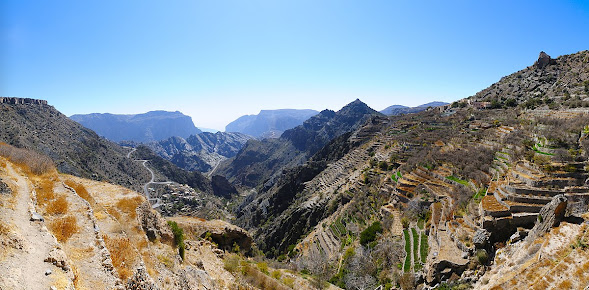
En route to Al Hamra, the journey passes through Wadi Ghul, a terraced farming village near Jebel Shams, Oman’s highest peak, worth a brief stop for its agricultural landscape.
Overnight: The View Oman, Al Hamra (half board)
Day 2: Al Hamra, Misfat Al Abriyeen & Al Hoota Cave
Highlights: mountain village of Misfat Al Abriyeen, Al Hoota Cave
Departing The View Oman at 08:00, the day begins in Misfat Al Abriyeen, a mountain village built from stone centuries ago and still irrigated by a traditional falaj channel system, with date palm terraces cascading down the hillside.
The second stop is Al Hoota Cave, an extensive limestone cave system with a subterranean lake and dramatic natural formations, a striking contrast to the exposed mountain terrain above ground.
The remainder of the day is left unstructured. Guests can use the infinity pool at The View Oman, book a treatment at Falak Spa (charged separately), or walk the property’s mountain-view pathways at a pace of their own choosing.
Overnight: The View Oman, Al Hamra (half board)
Day 3: Al Hamra to Wahiba Sands Desert Safari
Highlights: Wahiba Sands dunes, Bedouin camp visit, choice of sunset camel ride or dinner on the dunes
After breakfast, departure is at 08:00 for Wahiba Sands, a desert of red and white dunes reaching up to 200 metres, home to a surprising range of desert flora and fauna given the terrain.
A stop at a Bedouin camp offers an introduction to nomadic desert life and traditional hospitality, still practised much as it has been for generations.
On arrival at Arabian Nights Resort & Spa, the pool overlooks the open desert, and Rihla Spa offers treatments for those wanting to unwind. Quad biking across the dunes is available for guests seeking a more active afternoon.
Choose one evening experience:
- Sunset camel ride: A quiet ride across the dunes as the light shifts through orange and pink at dusk.
- Dinner on the dunes: A traditional Arabian dinner served in the open desert beneath the stars.
Overnight: Arabian Nights Resort & Spa (half board)
Day 4: Wahiba Sands to Wadi Bani Khalid & Desert Safari
Highlights: choice of sunrise camel ride or hot air balloon, Wadi Bani Khalid pools, Bedouin-guided camel trek, desert picnic
Choose one sunrise experience, departing 06:00:
- Sunrise camel ride: A calm ride through the desert as dawn colours the dunes.
- Hot air balloon flight: An aerial view over Wahiba Sands as the sun rises, showing the scale of the dune field from above.
The day continues at Wadi Bani Khalid, one of Oman’s most photographed wadis, where clear pools sit among striking rock formations. Swimming is possible in the cooler, deeper pools.
A guided camel trek follows, led by Bedouin guides who share knowledge of the desert ecosystem and local history built over generations of living in this landscape. The excursion closes with a traditional Omani picnic lunch set up in the desert, with dune views throughout.
Overnight: Arabian Nights Resort & Spa (half board)
Day 5: Wahiba Sands to Sur to Muscat
Highlights: Sur fish jetty and dhow yard, Al-Ayjah Lighthouse, Fins Beach, Bimah Sinkhole, Wadi Arbayeen
After breakfast, the route heads to Sur, a coastal town with a long maritime history. At the fish jetty, the daily rhythm of local fishing life is still visible. Nearby, a traditional dhow yard shows shipbuilding techniques largely unchanged for centuries. The dhow Fatah Al Khair, built more than 70 years ago entirely without nails, is on view here (boarding is not permitted, though the vessel can be seen up close).
A short stop follows at Al-Ayjah Lighthouse, originally built by the Portuguese and later adapted to guide wooden dhows into harbour.
The coastal drive continues to Fins Beach, where the water is clear enough for a swim, before reaching Bimah Sinkhole, a limestone crater with blue-green water formed by the collapse of an underground cavern, one of Oman’s more unusual natural landmarks.
The final stop is Wadi Arbayeen, where date-palm-shaded pools offer a last quiet moment before the drive back to Muscat via Wadi Mazara. The tour concludes with check-in at your Muscat hotel.