
Sunrise Over Dunes, Silence in the Mountains
There is a version of Oman that most visitors never reach: a Bedouin household tucked into the folds of Wahiba Sands, a 17th-century castle ceiling painted by hands whose names were never recorded, a lighthouse the Portuguese built and the desert quietly reclaimed. This three-day route from Muscat is built around that Oman, the one that rewards unhurried travel and a genuine interest in craftsmanship over checklists.
Designed for couples and small groups who already know Dubai or Doha and are looking for something quieter and more textured, this itinerary moves at a deliberate pace: mountain villages in the morning, dunes by afternoon, and the Arabian Sea by the third day. Private 4WD transport and an English-speaking chauffeur are included throughout, so the only decision left to make is how early to rise for the desert sunrise.
Why Choose Oman Over the Gulf’s Better-Known Destinations
Oman’s appeal lies less in scale than in restraint. The country holds five UNESCO World Heritage sites, yet its forts, souks and wadis remain largely uncrowded compared with neighbouring destinations. Crime is negligible, hospitality is unforced rather than performed, and the landscape itself, from the Hajar Mountains to the Wahiba dunes, does most of the work of impressing a well-travelled guest.
For travelers weighing Oman against the UAE or Qatar, the distinction is one of texture: fewer skyscrapers, more silversmiths; fewer beach clubs, more wadis you reach by 4WD and have largely to yourself. Luxury in Oman tends to mean privacy and craftsmanship rather than volume.
Day 1: Muscat to Nizwa to Al Hamra
Departure: 08:00 from Muscat Distance covered: Approximately 450 km Overnight: The View Oman, Al Hamra (half board)
The first day traces Oman’s interior heritage. Nizwa, long regarded as the birthplace of Islam in the Sultanate and capital of the interior region, is the day’s opening stop. Its souq is known for hand-carved khanjars, the traditional curved daggers, and finely worked silver jewellery, making it one of the more rewarding stops in Oman for those interested in traditional metalwork.
From Nizwa, the route continues to Jabrin Castle, built in the late 17th century and once a centre of Omani scholarship. The castle is considered one of the finest examples of Omani architecture, notable for its painted ceilings and detailed woodcarving, both regarded as among the country’s highest achievements in decorative craftsmanship.
En route to Jebel Shams, the drive pauses at Wadi Ghul, a terraced farming village set into the mountainside, before the day concludes with check-in at The View Oman in Al Hamra.
Day 2: Al Hamra to Wahiba Sands
Departure: 08:00 from Al Hamra Overnight: Arabian Nights Resort and Spa, Wahiba Sands (half board)
The second day shifts from stone architecture to landscape. A short visit to Misfah, a mountain village where original stone dwellings are still inhabited, precedes the drive to Wahiba Sands, a sea of red and white dunes reaching up to 200 metres, home to a surprising range of desert flora and fauna and a stop that photographers in particular tend to linger over.
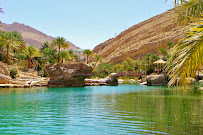
A visit to a Bedouin household within the dunes offers a direct look at desert life, in contrast to the next stop, Wadi Bani Khalid, where small villages sit among the mountains beside clear, deep blue pools. The group returns to the desert camp in time for sunset over the dunes, followed by an overnight stay at Arabian Nights Resort and Spa.
Day 3: Wahiba Sands to Sur to Muscat
Overnight: Return to Muscat (own accommodation)
The final day opens with a choice of sunrise experience, best arranged the evening before:
- Camel ride at 6:00 AM, a quiet route through the dunes as the sun rises over the desert.
- Hot air balloon at 6:00 AM, offering a panoramic aerial view of the dune field at first light.
After breakfast at the resort, the 08:00 departure heads to Sur, Oman’s traditional shipbuilding town. Highlights include the Fish Jetty and the traditional dhow factory (closed on Fridays), followed by a photo stop at Fatah Al Khair, a wooden dhow built more than 70 years ago without a single nail, its planks joined instead with hand-woven rope, now preserved as part of an open-air museum. Visitors can view the vessel closely but are not permitted to board it.
The route continues to the Al-Ayjah Lighthouse (photo stop only), originally a Portuguese defensive tower later converted to guide dhows safely into harbour. From there, the day turns coastal with a swim stop at Fins Beach, followed by the Bimah Sinkhole, a limestone crater with striking blue-green water at its base.
The final stop is Wadi Arbayeen, where deep, cool pools sit among date palms, before the return drive to Muscat via Wadi Mazara and check-in at your Muscat hotel.
Note: This day involves moderate walking on uneven terrain. Light, closed walking shoes and breathable cotton clothing are recommended, and the pace suits physically active travelers best.